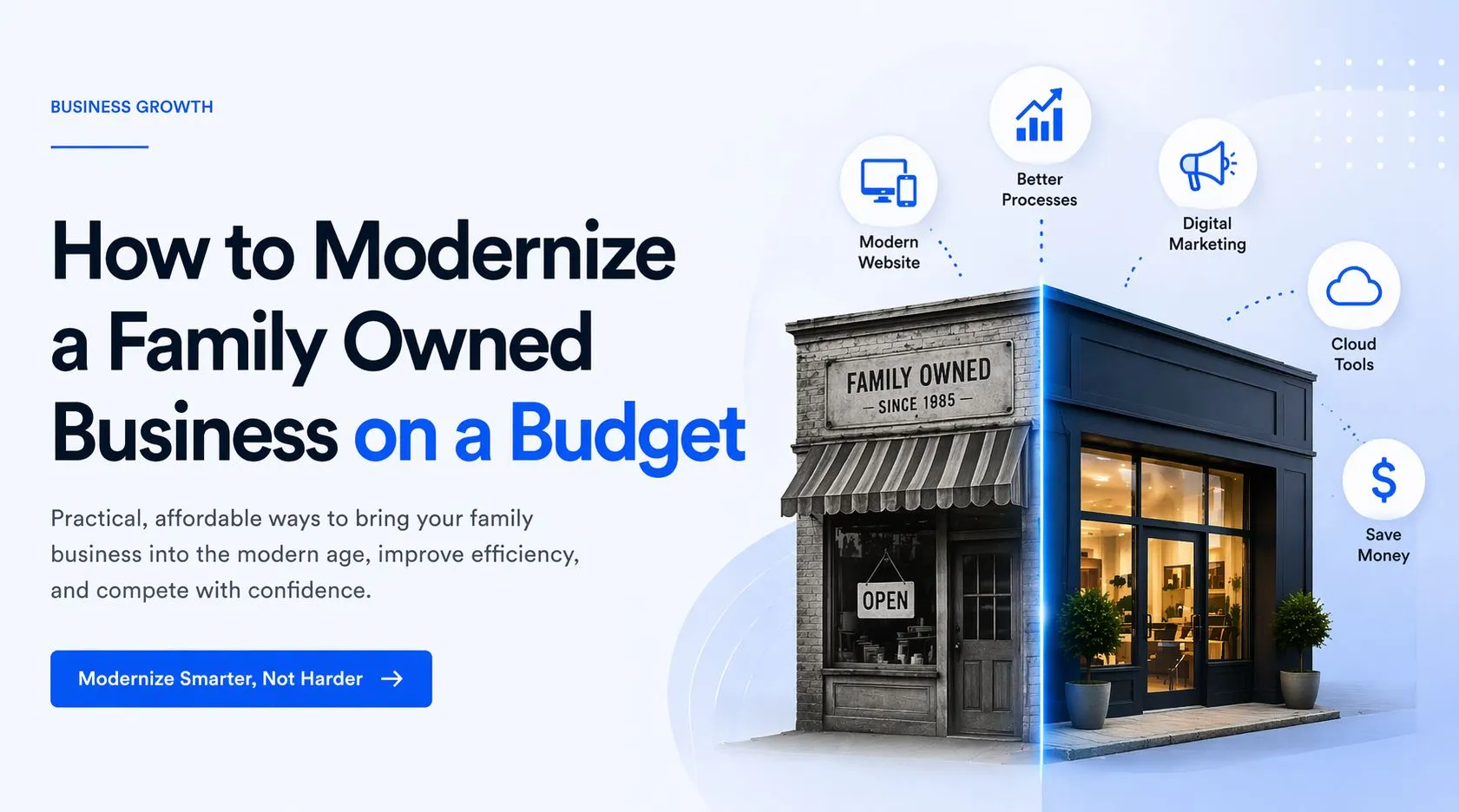
How to Modernize a Family Owned Business on a Budget
Modernizing a family-owned business doesn't require a huge budget. Learn practical steps to improve trust, visibility, and customer calls without overspending.
I've spent years in tech, startups, AI, and SaaS. I worked with mid-market and enterprise companies, and I saw what the right systems can do when a business has money, support, and time. Then I looked at local family businesses and saw a huge gap.
These are regular people. Families. Owners paying bills, supporting kids, and trying to build something that lasts. They are often amazing at the actual work. They fix homes. They solve urgent problems. They keep communities running. But when it comes to technology, a lot of them get locked out.
That never sat right with me.
This is personal for me. I grew up in a family that did not have a lot of resources. I had to work harder for opportunities that people just wake up with. I also come from a family of small business owners, so I know a business expense is never just a line item. That money might be payroll. It might be rent. It might be groceries. It might be tuition.
So when I talk about modernizing a family owned business on a budget, I am not talking about buying shiny tools so you can say you are modern. I am talking about helping you get found, build trust faster, and turn more visitors into actual customers. I am talking about making technology and resources accessible for everyone.
You do not need to become a tech expert. You do not need AI literacy. You need a business presence online that clearly shows what you do, where you do it, and how someone can hire you fast.
Why Family Businesses Get Stuck
The real problem is risk
Most family businesses are not behind because they do not care. They are behind because the options in front of them are bad.
The traditional agency model asks a small business owner to pay $3,000 to $10,000 upfront, wait weeks or months, and hope the site turns into results. For a family-run shop, that creates pressure immediately. I've said this a lot because I see it all the time: agencies build, deliver, and disappear. Meanwhile, the business owner still needs edits, updates, changes, and help.
A website should be treated like a living sales tool. It should keep working for you. It should keep improving. It should be consistently selling for you 24 seven.
One situation really stuck with me. I was talking to a family-owned home service business. Good people. Solid work. Their website was outdated, slow, and unclear. It did not reflect how good they actually were. When the usual agency range of around $4,000 to $10,000 came up, the owner got quiet and said, "That's a lot. What if it doesn't bring anything in?"
That moment says everything.
He was not thinking about design trends. He was thinking about payroll, equipment, family, and whether one wrong decision would hurt the business. When owners say, "Let me think about it," a lot of the time they are trying to protect their household from a bad bet.
That is why I built my whole approach around removing risk. If you want to modernize on a budget, start there. Pick a model that does not force you to gamble a huge chunk of cash before you see value. Most business owners care about calls, leads, and revenue. They do not wake up wanting to buy pages and features.
Word-of-mouth still matters, but buyers check online anyway
Word-of-mouth is powerful. It always will be. In fact, 85% of small businesses say customers find them through referrals.
That part is real. I respect it.
But the buyer journey changed. Today, 93% of U.S. consumers have searched online for a local business in the last year. And BrightLocal found that 34% do it daily and 73% do it at least weekly. So yes, somebody may hear about you from a friend. Then they still go look you up.
I say this all the time: if someone got a referral, they probably got two or three other referrals too.
Then they compare. They look at photos. They look at reviews. They look at the website. They ask themselves one simple question: which company makes me feel most confident in their work?
I've done this myself. After moving to a new city, I got barbershop recommendations from friends. I still did not book right away. I looked them up. I wanted to see examples of the cuts. I could not find enough visual proof, so I moved on. The referrals were there. The online trust was not.
That happens to local businesses every day.
If your site is outdated, cluttered, or cheap-looking, people start thinking, if their website looks like this, what about their service? You can lose a customer before they even read a word.
Fix What Buyers See First
Your homepage needs to pass the 30-second test
A lot of family business websites try to tell the whole story at once. They open with "Welcome to our website" or "Family owned since 1998" and then stack paragraph after paragraph underneath it. I understand why. Owners are proud of what they built. They should be.
But your homepage has a job to do.
It needs to pass the 30-second test. When someone lands on it, they should clearly understand what you do immediately in the first 30 seconds. They should know whether you serve their area. They should know whether you can solve their problem. And they should know what to do next.
For a plumber, HVAC company, electrician, roofer, landscaper, or any local service business, the customer is not visiting your site to admire your story. They are trying to solve something. They want to understand what you do, how you fix it, and how to get in contact with you.
That means your homepage should lead with what you do plus why you're better and what to do next. Keep your family history. Just move it to an About page where it can breathe. On the homepage, clarity wins.
If you run an emergency service business, this matters even more. During a home emergency, people do not care about perfection. They care about speed. They want to know whether you can help right now.
Show proof, not promises
One of the cheapest ways to modernize your business is also one of the most effective.
Use real photos.
Stock photos of people shaking hands, smiling in offices, or pretending to work do not build trust. They feel like filler. They make the business feel less real. I always want actual photos of the team, the trucks, the projects, and the results.
If you do physical work, show before-and-after photos. Show close-ups. Show the finish. Show what your ideal customer is hoping to see.
Reviews matter too. A lot. BrightLocal found that 87% of consumers read online reviews for local businesses, and only 48% would use a business rated under 4 stars. That number kept climbing. A later BrightLocal survey showed 97% of consumers read reviews for local businesses.
That tells you something simple. Buyers are benchmarking you before they call.
So show real testimonials. Use full names when you can. Add real details. Pair them with project photos. Premium clients are risk-aware. They trust proof more than claims.
Your copy should help too. If you want better jobs, stop filling your site with cheap language. Cheap attracts cheap. High-paying homeowners associate cheap with risk. They want confidence, not bargains.
I've seen this shift happen with a local home service business. Their old site pulled in price shoppers. After the site was rebuilt with better visuals and stronger premium messaging, the conversation changed. People stopped asking if they were the cheapest. They started asking when they could start.
Make It Easy to Call, Text, and Book
Mobile speed matters more than fancy design
Most local service traffic is happening on phones. Your site has to work there first. It has to load fast, look clean, and make contact easy.
The data backs this up. 98% of consumers say they want to connect with businesses on mobile devices. And 70% of mobile searchers say they click to call a business directly from search results. Google also says click-to-call ads drive 40 million calls per month to businesses.
So if your phone number is hard to find, or your site makes people zoom, pinch, and hunt around, you are creating friction where you should be creating speed.
Site speed matters just as much. Google's research shows that a 1-second delay in mobile page load time can cut conversions by up to 20%, and 62% of users are less likely to buy after a poor mobile experience.
This is why I keep designs simple. I limit fonts. I compress images. I cut unnecessary animations. I remove hidden bloat. Sometimes a website looks decent, but it loads like a brick. That hurts you more than people realize.
Speed is not just a technical detail. It is the difference between a homeowner staying, leaving, or calling your competitor.
Human connection still wins
I work in AI and tech, so I am not anti-technology. I just believe technology should help people, not trap them.
Sometimes people just want to talk to people.
That is especially true in local service. If someone has a burst pipe or broken AC, they do not want to get stuck in a chatbot loop. They want a fast answer. They want to know somebody is there.
That is why I do not recommend chatbots on local sites unless there is a real human behind the response. In urgent situations, bots can push people away.
A modern business should make contact feel easy. Put call buttons where people can see them. Put text options on mobile. Use forms if you cannot answer right away so you can collect contact info and follow up. If phones are a bottleneck, use a system that can answer and book on your behalf.
And meet people where they are. Some owners like calls. Some like texts. Some like voice notes. I adapt to that because people buy from people.
Help Google Understand Your Business
Start with the fundamentals
A lot of owners think Google is hiding them. Usually, Google just does not understand them still.
If you are not showing up, it is often missing signals.
When I look at a local business that wants better visibility, I start with the fundamentals. I look at the Google Business Profile. I make sure the website language matches what people actually search, which usually means clear service-plus-city terms. I make sure reviews are coming in. I check that the business name, address, and phone number match everywhere online. Then I clean up the website experience so it is easier for people and easier for Google.
That work helps you rank higher on Google, so Google can know you exist.
It also helps that people usually check your Google Business Profile first when they want reviews. If that profile is weak, inconsistent, or half-finished, you are making it harder for people to trust you.
If you want premium work, go a step further. Build pages around the exact cities or neighborhoods you want to serve. I talk about this a lot because high-paying homeowners think differently, search differently, and choose differently. If you want projects in areas like Palo Alto, Los Altos, or Saratoga, your site should say that clearly. General language brings general traffic.
Protect the traffic you already have
This part gets overlooked all the time.
If you already have a site and some pages are ranking, do not wipe everything out during a redesign. I use in-house audits to see which pages are already bringing traffic. Then I recreate those pages and redirect them properly. That protects the search visibility the business already earned.
Small business owners cannot afford to lose the little momentum they have. So be careful with redesigns. A better-looking site that kills your rankings is not a win.
Reviews help here too. Keep your review process simple and organic. Right after the service is done, ask. Make it easy. Hand the customer a card they can scan. If you want to add a small thank-you discount for next time, do it in a genuine way. It feels natural, and it works.
Customers are already comfortable leaving feedback. 72% of consumers have written a review for a local business. You just need to ask at the right moment.
And do not rely only on Instagram to show your work. Post detailed before-and-after photos on Google too. Instagram mostly reaches people who already follow you. Google reaches people actively looking for help.
Spend Smarter, Not Bigger
Cheap can cost you more
A family business trying to save money can fall into two traps fast. One is the big agency bill that creates stress before anything goes live. The other is the "free" or DIY route that eats time and still makes the business look weak.
I have seen both.
I worked with a car wash business whose site had been built by a nephew five years earlier. It was outdated and hard to access. It looked more like a placeholder than a business asset. I also had a recent client who wasted $600 on an agency that built a poor site and would not make the edits they needed.
So yes, a lower upfront price can still become expensive.
And then there is the cost nobody talks about enough: your time. A lot of owners spend nights and weekends trying to figure out builders, templates, domains, hosting, and edits. Meanwhile, they could be doing revenue-generating work or spending time with family. They get home, they are exhausted, they want to spend time with their families.
If you really want to modernize on a budget, stop paying for the wrong things. Do not obsess over trendy features. Do not buy a bunch of disconnected tools. Do not get distracted by platform debates either. I custom-code my websites because it gives me more control and helps me reduce costs. But in general, the platform matters less than whether the person building it understands local SEO, speed, and conversion.
Buy a system you can actually live with
Keep the basics simple.
Your domain is your name on the internet. Hosting is what puts that name online. SSL is the security layer that helps protect the site. Those things matter, but they should not feel complicated or scattered across five invoices.
Modernization gets easier when everything is bundled into one system. That includes the domain, hosting, updates, backups, security, and a branded business email if you need one. Predictable costs matter. No surprise bills. No weird lock-in. No feeling like your whole wallet is on the line.
That is why I built WeGotSites the way I did. I wanted to bring in that enterprise feeling for these small businesses while keeping it simple and affordable. We build a custom preview first, before the client pays. We keep it month to month. We offer no contracts because I believe you should earn the business every month. We also give unlimited text and photo updates so the website can grow with the business.
Even if you never work with my company, I still believe the model matters. The right setup removes fear. Once that happens, the conversation shifts. I have watched owners go from worrying about the risk to asking when they can start.
If Your Budget Is Tight, Start Here
Focus on the moves that actually change buying behavior
If money is tight, I would start with the homepage and the mobile contact flow. Make sure a visitor can tell what you do, where you work, and how to reach you within seconds. Put your phone number where people can see it. Add a clear call to action. Make it easy to call or text.
Then I would replace every fake image with real proof. Real projects. Real faces. Real trucks. Real testimonials. This alone can change how people see your business.
Right after that, I would tighten up the Google side. Clean up your Google Business Profile. Make sure your business information matches everywhere online. Start asking for reviews right after the job is done. Those are low-cost moves, but they help people trust you and help you look better in Google's eyes.
Keep building from there
Once the basics are strong, refine the message.
If you want higher-paying work, speak about outcomes, not services. Talk about what improves for the customer. Talk about craftsmanship, speed, trust, clean execution, less stress, and better results. Show proof. If you want to serve better neighborhoods, create pages for those areas. If you want to be known for a specific type of work, lead with that specialty.
You do not need a giant site to do this. Sometimes a simpler, more intentional website will beat a bigger one. Sometimes websites that are over-engineered hurt you more than they help you.
Keep updating it. Keep improving it. Keep treating it like part of the business, not something you launched once and forgot about.
Final Thought
I care deeply about this because small businesses are the backbone of the US. A lot of the owners I work with come from the same kind of background I do. Limited resources. No shortcuts. No cushion for bad decisions.
That is exactly why modernizing on a budget matters.
You should have access to the same kind of digital advantage bigger companies use, without taking on the same kind of risk. You should be able to look professional, build trust, get found, and win more customers without going into debt over a website.
A few extra clients a month can change a family's life. It can help pay bills. It can create breathing room. It can open doors for your kids. That is why I do this. I want to help small businesses do what they do best and allow us to highlight what they do best, so they do not get left behind by technology.
Frequently Asked Questions
How do I compete with big corporate franchises that have massive marketing budgets?
You don't outspend them. You out-trust them. Corporate sites feel cold. Show your actual team and local projects. 93% of consumers searched online for a local business last year. If your mobile site is fast and your Google reviews are authentic, locals will choose a real family over a faceless franchise every time.
Should I just use a Facebook page instead of paying for a website?
Social media is rented space. A website is your digital storefront. Facebook is great, but buyers needing immediate help go to Google. Remember, 70% of mobile searchers click-to-call directly from search results. If you only rely on social media, you are missing the exact moment a high-paying customer actually needs your service.
Do I need to buy expensive Google Ads to get local phone calls?
No, don't gamble on ads until your foundation is solid. Fix your Google Business Profile and website first. Google delivers 40 million calls per month via click-to-call. However, sending paid traffic to a slow, confusing website just burns your hard-earned cash. Master your free local SEO and reviews before ever paying for ads.
How do I get my older, word-of-mouth customers to trust my new digital setup?
You don't force them to change. You just make it easier for them to refer you. 85% of small businesses still rely on word-of-mouth. When your legacy customers tell their neighbors about you, those neighbors will immediately look you up online. A clean, professional website simply proves that their personal recommendation was right.
I don't have time to write website content or figure out updates. What do I do?
You shouldn't be writing code or content after a 12-hour shift. That takes time away from your family. This is exactly why you need a partner, not just a generic template. Look for a service that handles unlimited text and photo updates for a flat monthly fee, so you can just send a quick text and go sleep.